Download
TBD
Abstract
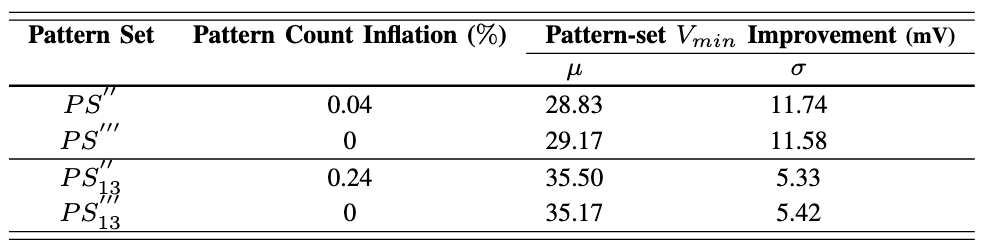
At-speed logic scan tests are an important tool to ensure desired quality in mobile chips. During initial test pattern bring-up, tests that exhibit an unexpectedly high $V_{min}$ pose a risk of over-testing and production yield loss. This is particularly problematic if the $V_{min}$ of the test is significantly higher than that of the functional system workloads. In such situations, the at-speed logic scan test is debugged to find and resolve the source of the high $V_{min}$. This paper describes an example case study of $V_{min}$ debug, in which a series of experiments are performed to identify the root cause as individual test patterns that capture the responses of unconstrained paths. We propose pre-silicon and post-silicon methods to improve $V_{min}$ by preventing problematic patterns and reducing the debug effort during test bring-up. Our methods have been verified on ATE to effectively improve $V_{min}$ by 28.83mV to 39.33mV with 0% to 0.5% pattern count inflation.
Figure 1: Results of Pre-silicon Method

Figure 2: Results of Post-silicon Method
Citation
TBD