Project Information
Project Type: Course Final Project
Course: Physical Design for Nanometer ICs
Description
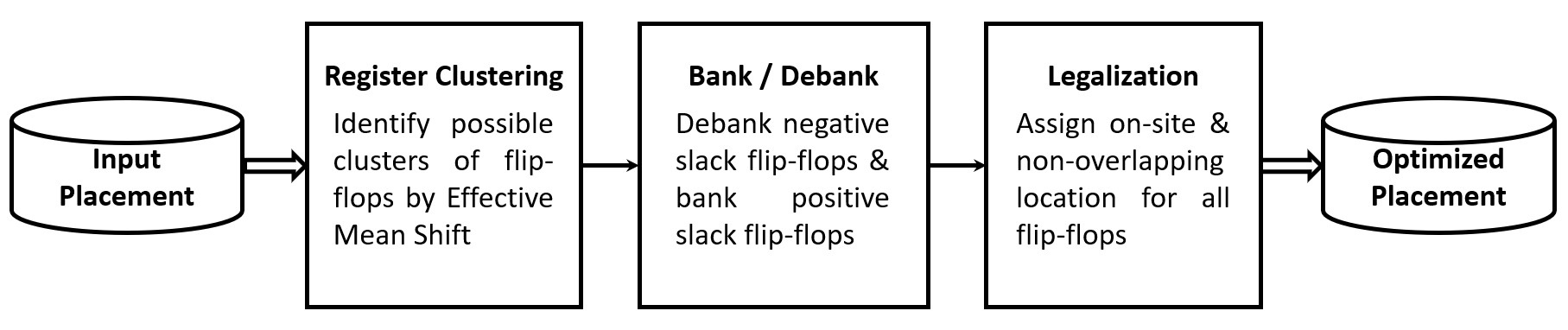
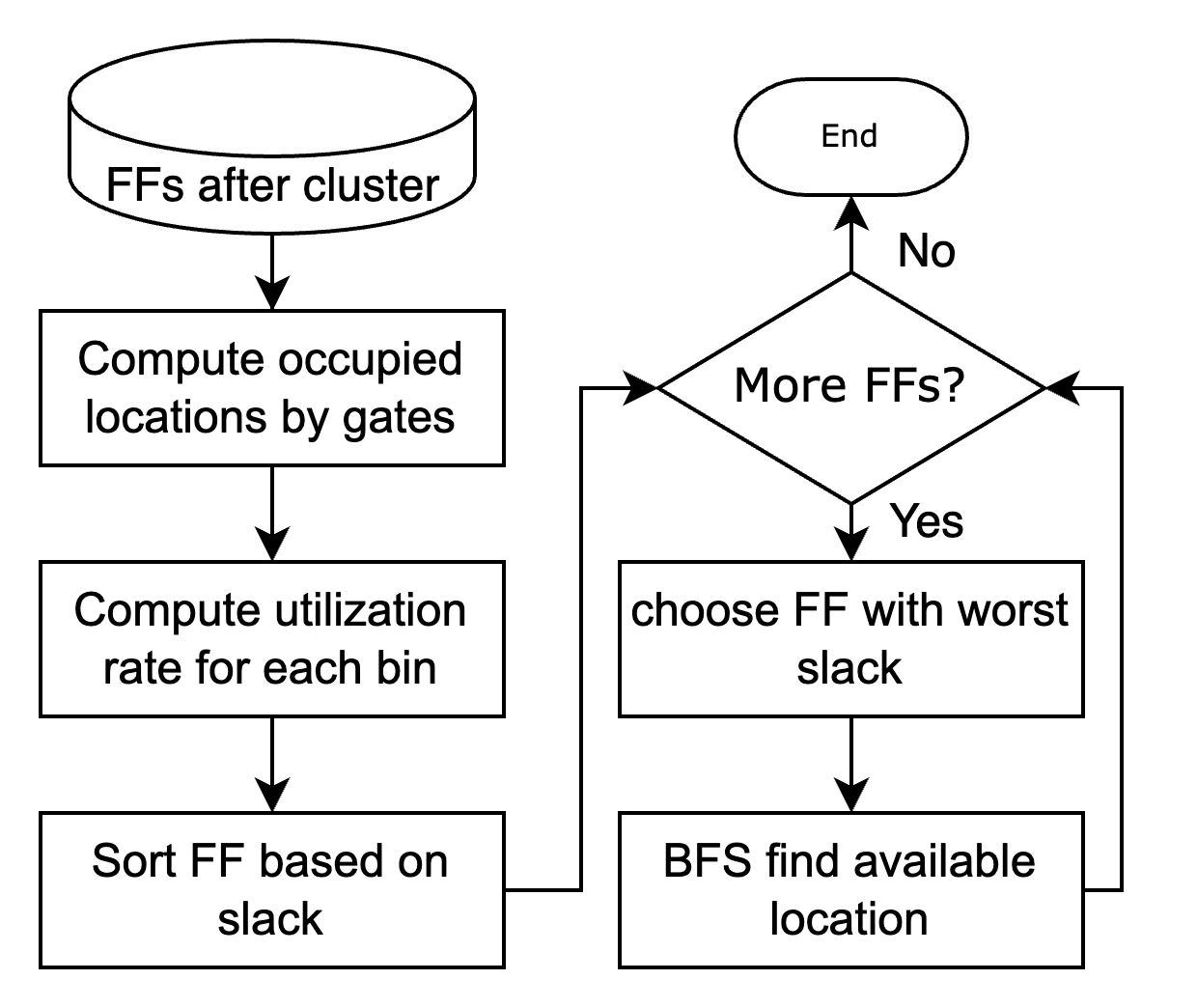
This project focuses on optimizing power, timing, and area in digital circuit design through the application of multibit flip-flop (MBFF) techniques. By modifying the effective mean shift algorithm, we developed a three-step flow consisting of register clustering, banking and debanking, and legalization. In the clustering stage, flip-flops are grouped using K-nearest neighbor (KNN) search and timing-aware bandwidth settings. Banking and debanking are then applied based on slack information with a multi-level merging strategy to balance timing and power. Finally, a breadth-first search (BFS)–based legalization ensures all flip-flops are placed legally under utilization and overlap constraints. Experimental results on ICCAD benchmark data show that our method can achieve up to 91% cost reduction in the best case and around 30% reduction under reasonable settings. Overall, the proposed flow effectively integrates clustering and legalization techniques to improve circuit performance while maintaining timing feasibility.
Method
Figure 1: Overall Flow
In this project, I am mainly in charge of legalization step.
Figure 2: Flow of Legalization
Results
Figure 3: Slack Limits and Corresponding Data
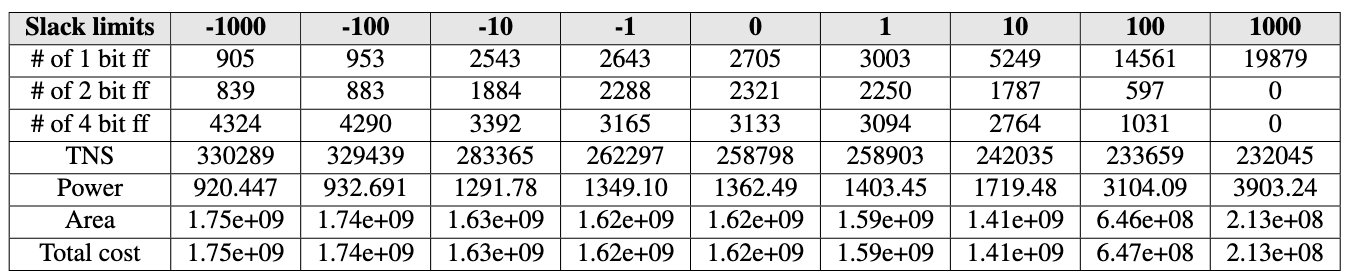
Figure 4: Final Result
